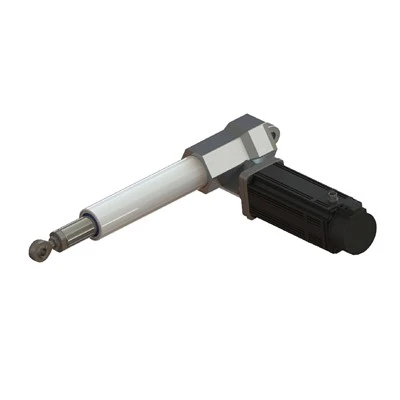
A Linear Servo Electric Cylinder is an actuator that uses electrical energy to produce controlled linear reciprocating motion. It is widely used in industrial automation, machining, material handling, and precision positioning applications. Its core operating principle is to convert the rotary motion of a servo motor into linear motion and regulate that motion through a control system, allowing the equipment to perform pushing, pulling, positioning, pressing, and other operations according to predefined requirements.
During operation, the servo motor first receives commands from the control system. Based on the requirements of the application, the controller specifies the target position, movement direction, operating speed, and acceleration and deceleration profiles. The servo motor then generates rotary motion in accordance with these commands, providing power to the transmission mechanism. Unlike a conventional motor operating without advanced feedback control, a servo motor can work with a feedback system to adjust its operating state and better meet the motion control requirements of automated equipment.
The transmission mechanism is an essential component that enables the Linear Servo Electric Cylinder to produce linear motion. Common transmission options include ball screws, roller screws, and other mechanical transmission structures. When the servo motor drives the transmission mechanism, the internal nut, push rod, or associated moving component travels along the designated direction, converting rotary motion into linear displacement. Different transmission mechanisms have different characteristics in terms of motion smoothness, load capacity, efficiency, and maintenance requirements. The appropriate design should therefore be selected according to the intended application.
The piston rod or push rod transfers the generated linear motion to an external load. When connected to fixtures, worktables, robotic arms, or other moving components, the rod can extend, retract, or stop at designated positions according to the control commands. By configuring the motion parameters appropriately, a Linear Servo Electric Cylinder can meet the requirements for coordinated movement and operating sequences in automated production processes.
Position feedback is an important element of precise motion control. In systems equipped with suitable feedback devices, position sensors or encoders provide information about the actual motion state. The controller compares this information with the target command and adjusts the servo motor output according to the difference. This closed-loop control approach helps improve positioning performance and maintain the required motion behavior when the load or operating conditions change. Actual control performance depends on the mechanical design, feedback method, control algorithm, and working conditions.
In addition to position control, a Linear Servo Electric Cylinder can adjust movement speed, acceleration, and thrust-related parameters, depending on the system configuration. In applications such as pressing, assembly, and material handling, appropriate parameter settings help the actuator perform movements that meet process requirements. For example, reducing the speed as the rod approaches a workpiece can help minimize impact, while appropriate control during positioning can improve consistency between repeated operations.
Overall, a Linear Servo Electric Cylinder converts electrical energy into controlled linear motion through the coordinated operation of the servo motor, mechanical transmission mechanism, linear moving components, and control system. Its flexible control capabilities and high level of automation make it suitable for industrial equipment requiring precise control of position, speed, and motion.