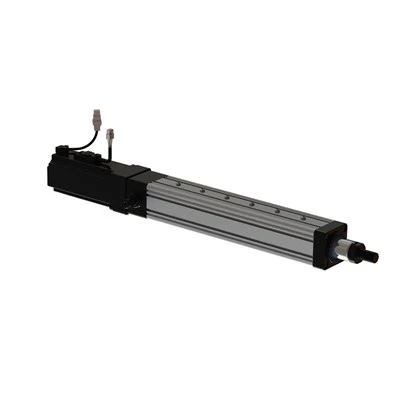
A qualified Heavy Duty Linear Actuator will not suffer structural loosening, component disengagement, or connection shaking under standard installation, proper handling, and normal working conditions. It delivers extremely high overall structural stability and reliability. It withstands long‑term high‑frequency reciprocating cycles and continuous loaded operation without easy degradation of fastening performance over service time, which represents core quality assurance for industrial‑grade actuators.
From manufacturing and assembly perspectives, the Heavy Duty Linear Actuator is assembled with high‑precision fitting procedures. All connected parts and fixing structures go through accurate alignment and locking reinforcement. Components fit closely and fastening points remain secure without oversized assembly gaps or inadequate clamping. Before delivery, every unit completes professional vibration testing, high‑frequency reciprocating fatigue testing, and loaded shaking testing simulating long‑term complicated running scenarios to eliminate hidden risks of structural looseness and poor connections. Factory‑released units achieve firm assembly and qualified stability, preventing running‑related loosening from the production source.

Under regular practical working scenarios including low‑speed fixed‑point movement, uniform reciprocating push‑pull, and high‑frequency repeated start‑stop cycles, the complete machine, transmission assemblies, and connection points stay tightly fastened. There exists no body shaking, component loosening, abnormal connection noise, or positional offset. The equipment maintains stable gravity distribution and good structural integrity during operation. Even with extended non‑stop working hours, fastening conditions remain unchanged, and mechanical vibration plus regular load stress will not trigger loosening.
Loosening concerns raised by users mostly result from improper external usage rather than inherent structural defects. The first cause is non‑standard installation. Misaligned mounting, insufficiently tightened fastening points, or unstable mounting bases cause uneven equipment stress, which brings connection loosening after prolonged vibration. The second is impact‑prone misuse. Sudden over‑limit loading and violent start‑stop create instant excessive impact force on structures, and cumulative effects may produce minor relaxation at connecting points. The third covers persistent high‑intensity vibration environments far exceeding standard working‑condition requirements, which accelerates relaxation of fastening points.
It should be clarified that such loosening risks are fully avoidable. Initial manifestations are merely minor connection relaxation instead of direct threats to operational safety and core performance. Firm alignment and tightening during installation plus stable mounting bases and avoidance of impact‑causing over‑limit misuse sustain permanent compact structures free from loosening hazards. Compared with small‑size ordinary actuators, the Heavy Duty Linear Actuator optimizes fastening structures for heavy‑duty applications with more reinforced positions, higher structural rigidity, and greatly enhanced anti‑vibration, anti‑loosening, and anti‑deformation capacity.
Throughout long‑term service life, only simple visual fastening inspections are needed without complex maintenance work to preserve overall structural stability. Running‑related loosening, shaking, and offset can be thoroughly prevented. The actuator reliably executes diverse heavy‑duty linear‑driving tasks and secures safe, smooth, and dependable performance for full sets of equipment.