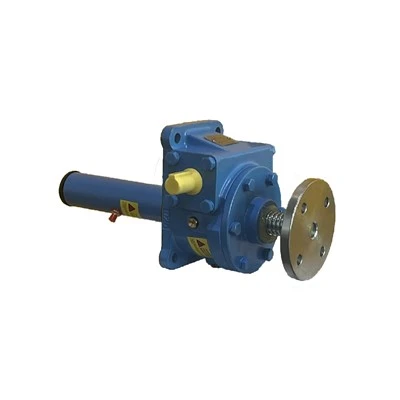
Whether the operating noise of the Worm Screw Jack is loud is a practical concern raised by many users in the early‑stage selection phase. Noise directly shapes on‑site working experience and influences the operational feel of surrounding areas after the full set of equipment is assembled. Many users worry that loud operating noise will disturb on‑site operators or exert extra impacts on other nearby matched equipment, which makes them pay close attention to the real‑world noise performance of this lifting device.
First of all, it should be clarified that the structural design of the Worm Screw Jack inherently delivers soft running sound. The meshing transmission mode of the worm‑and‑worm‑gear set enables smooth transition during engagement, avoiding sharp and abrupt impact noises, which lays a solid foundation for the equipment's low‑noise performance. Nevertheless, this does not mean that operating sound will remain identical under all application conditions. In real‑world applications, the noise perceived by human observers is not only generated by the jack itself, but represents a comprehensive acoustic effect superimposed by multiple practical conditions.
During no‑load operation, transmission components bear little pressure and friction remains mild, so overall operating sound stays within a desirable range, featuring soft, uniform acoustics free of fluctuating abnormal noises. When the equipment shifts to loaded operation, changing bearing conditions increase stress on transmission parts and the degree of frictional contact accordingly, bringing about a moderate rise in noise - this counts as a normal working phenomenon. Such variation remains limited and will not turn into harsh, clamorous noise. As long as operation stays within reasonable working ranges, sound performance can still fit most ordinary working environments.
Working environments themselves exert obvious influences on perceived noise levels. Sound tends to reflect and reverberate in confined, compact indoor spaces, making identical operating noise subjectively more noticeable. By contrast, sound dissipates freely in open, well‑ventilated sites, so noise sensed by human ears becomes weaker. Even the same Worm Screw Jack will produce divergent subjective acoustic feedback in different spatial surroundings. In many cases, increased perceived noise does not stem from the jack itself but results from environmental sound amplification.
External matched components can also produce extra sound sources. The Worm Screw Jack operates in linkage with external structures. Clearances and contact status between external connected parts may generate additional noise from vibration and collision, which is frequently misjudged as abnormal noise originating from the Worm Screw Jack itself.
Working modes also deserve attention. Steady, constant lifting maintains stable transmission and consistent sound output. Frequent start‑stop actions and repeated lifting‑lowering switching continuously change component stress states and cause sound fluctuations. Dust and debris entering contact positions may introduce extra frictional noise and alter overall acoustic performance.
Users need to distinguish uniform normal operating sound from abnormal harsh noise. Smooth, even running sound represents normal equipment operation. Sharp, intermittent or impact‑type abnormal sounds indicate changes in on‑site application conditions. Relevant external factors should be checked instead of attributing problems directly to the equipment hardware.
Overall, the Worm Screw Jack features favorable inherent noise performance and adapts to most regular production scenarios. To achieve optimized low‑noise operation, users can adjust external application aspects including environmental layout, fitting conditions of matched assemblies and control of working modes. Extra noise triggered by external factors can be avoided so that the inherent low‑noise advantages of the transmission structure can be fully leveraged. Operating sound will stay at a satisfying level and accommodate various scenarios with certain acoustic requirements.