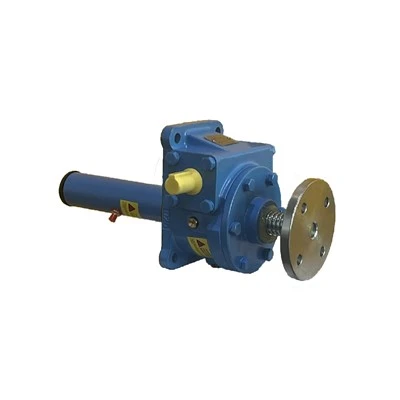
The Heavy Duty Linear Actuator achieves outstanding overall action response speed marked by rapid reaction, zero perceptible lag, uniform velocity, precise start‑stop, and sensitive direction‑changing capacity. It fully meets requirements from industrial automated workflows, high‑precision equipment driving, and high‑frequency reciprocating applications and forms a vital practical advantage. It addresses pain points of traditional driving devices including slow reaction, prominent delay, and unstable velocity.
In terms of power‑transfer principles, the Heavy Duty Linear Actuator adopts direct‑coupled transmission with highly streamlined power‑transfer routes. It discards complex intermediate transmission structures seen in hydraulic and pneumatic alternatives and removes the need for medium buffering and pressure build‑up. After receiving control commands, it outputs power immediately and triggers extension, retraction, push, pull, lifting, and direction‑switching motions with nearly imperceptible delay. Start‑stop actions are decisive and movements connect coherently without waiting, sluggishness, or slow startup after command input for excellent instant‑response capacity.
In single‑operation applications, response speed for fixed‑point extension‑retraction, positioning push‑pull, and start‑stop braking remains precise and stable. Startup, travelling, and stopping proceed at controllable uniform velocity without slow initial movement, mid‑travel acceleration, or deceleration‑related ending blockage. Reliable speed control supports positioning‑critical and smooth‑driving requirements for precision equipment matching, fixed‑point lifting, and accurate push‑pull work and safeguards equipment running accuracy and stability.
Its merits in consistent response speed become more prominent under high‑frequency continuous reciprocating work. During non‑stop repeated start‑stop, direction‑switching, and telescopic cycles, response speed keeps uniform and stable without decelerated reaction, aggravated lag, or sluggish movements caused by continuous operation. Every command response maintains highly unified speed and rhythm, free from irregular velocity, action disorder, or response deviation. It perfectly adapts to assembly‑line continuous production, cyclic driving for automated machinery, and high‑intensity workflows with frequent large‑mechanism movements.
Meanwhile, the response speed of the Heavy Duty Linear Actuator features strong adaptability and matches regular industrial operation rhythms. It avoids excessive velocity that creates equipment shaking upon impact as well as overly slow movement that lowers working efficiency. Action rhythms stay smooth and controllable with high fault tolerance. Against hydraulic cylinders and air cylinders, it skips pressure establishment and medium conduction steps for faster and more consistent responses. Traditional devices face velocity discrepancies between hot‑cold states and response fluctuations amid load changes, while the Heavy Duty Linear Actuator is barely affected by minor variations of working‑site and load conditions and sustains steady responses throughout operation.
With proper operation and basic regular care across long‑term usage, its action response speed will not degrade, slow down, or suffer worsening lag. It retains sensitive and efficient reactions continuously, guarantees working efficiency and running accuracy of complete sets of equipment, and accommodates long‑duration, high‑frequency, and precision‑oriented industrial driving applications.

 English
- English
- Français
- Deutsch
- 日本語
- Italiano
- Español
- Português
- русский
- slovenščina
- Eesti
- Polski
- dansk
- O'zbek
- Melayu
- বাংলা
- עברית
- Kreyòl Ayisyen
- Türkçe
- Català
- Svenska
- Čeština
- اردو
- عربي
- हिंदी
- ไทย
- Latviešu
- Lietuvių
- فارسی
- Cymraeg
- bosanski
- slovenčina
- Gaeilgenah Éireann
- 한국어
- українська
- hrvatski
- íslenska
- Ελληνικά
- Srbija jezik (latinica)
- România limbi
- Malti
- Việt Nam
- Nederlands
- Indonesia
- Bai Miaowen
- suomi
- Norsk
- magyar
- Български