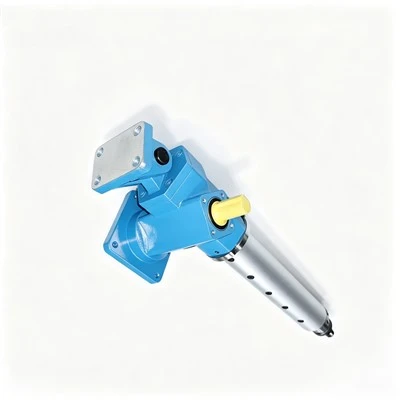
The operational stability of the High Precision Foldback Servo Electric Cylinder is one of its core competitive advantages and a key prerequisite for adapting to automated precision operations. Its overall performance is stable and reliable, capable of meeting the long-term operational requirements of multiple scenarios and high loads. It comprehensively lays a solid foundation for stable operation in terms of structural design, operational control, working condition adaptability, and long-term use. The details are as follows:
The scientific nature of the structural design is the fundamental guarantee for stable operation. The servo cylinder adopts an integrated foldback structure, which accurately integrates the motor and the cylinder body. The overall layout is compact and regular, effectively reducing the deviation of the center of gravity during operation, greatly minimizing operational vibration, and fundamentally avoiding operational jitter and deviation caused by loose structure and unstable center of gravity. The internal core transmission components undergo precision processing and strict assembly. Key components such as lead screws and gears have extremely high fit. During operation, frictional resistance is small and uniform, without abnormalities such as jamming or stagnation, ensuring smooth operation throughout the entire process and preventing issues affecting stability, such as uneven speed and action delay. Meanwhile, the body is made of high-strength wear-resistant material, featuring both impact resistance and deformation resistance. It can effectively protect internal components, avoid interference from external collisions and extrusion on operational stability, and is suitable for various conventional working environments such as workshops and laboratories.
The accuracy of operational control further enhances stability performance. The High Precision Foldback Servo Electric Cylinder is equipped with a high-precision servo control system, which can achieve precise control of operational speed, stroke, start-up, and shutdown. The power output is balanced and linear without obvious fluctuations, ensuring that each action is accurately controllable. In terms of start-stop connection, through special optimization design, it starts smoothly to avoid the impact of instantaneous shock on the equipment itself and operational accuracy; when shutting down, it lands stably without rigid jitter or shaking, and the operational posture remains regular and balanced. For the core working conditions of high-frequency folding and repeated start-stop in automated production, the servo system responds quickly and executes commands accurately. Even when operating continuously for several hours, it can maintain a stable operational rhythm, and there will be no issues such as command delay or action deviation as working hours increase, ensuring the continuity of the operational process.
The ability to adapt to multiple working conditions fully demonstrates its stability. Whether it is precision operation with low-speed fine-tuning or folding and reciprocating movement at medium and high speeds, the High Precision Foldback Servo Electric Cylinder can maintain a stable operational state and will not experience abnormalities such as jamming or deviation due to speed changes. For long-term continuous operation scenarios, its heat dissipation system has been optimized and upgraded, which can timely dissipate heat generated during operation, avoid performance degradation and unstable operation caused by overheating, and can realize 24-hour uninterrupted operation around the clock, meeting the high-intensity operational needs of assembly lines and automated production lines.
In practical application scenarios, its stability has been fully verified. Whether in precision mechanical processing, automated assembly, laboratory precision operations, warehousing and logistics automation, or other scenarios, the servo cylinder can perform stably, accurately completing each folding, pushing, and positioning action without affecting operational accuracy and efficiency due to unstable operation. Even in high-frequency and high-intensity working environments, it can maintain stable performance for a long time, effectively reducing equipment downtime caused by failures, improving overall operational efficiency, providing users with a reliable and stable transmission solution, and fully meeting the high requirements of various automated operations for equipment stability.