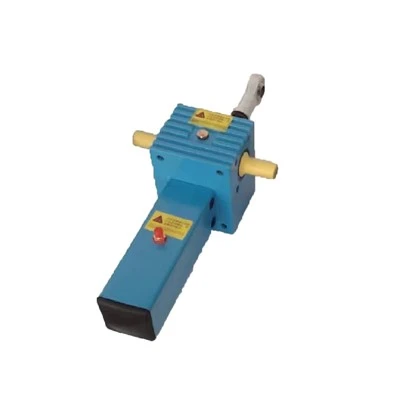
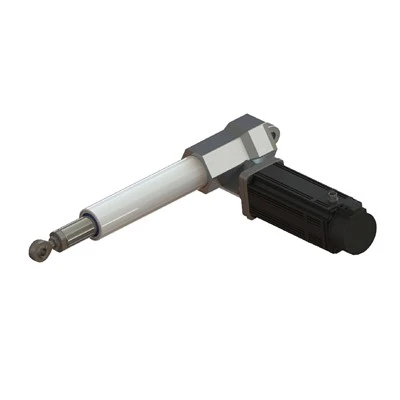
The basic working principle of an Industrial Electric Actuator is to convert the rotational movement generated by an electric motor into linear displacement through an internal mechanical transmission system. It generally consists of a drive motor, reduction mechanism, transmission mechanism, actuator rod, guiding structure, and related control components. Although different types of Industrial Electric Actuators may have different internal configurations, their core operating principle is similar: the motor drives mechanical transmission components to move the actuator rod in a specified direction.
When an Industrial Electric Actuator receives a start signal, its drive motor begins operating and generates rotational power. However, the motor's original rotational speed and output characteristics may not directly meet the requirements of the actual application. Therefore, a reduction mechanism is usually incorporated to adjust and transmit the motor's power. This mechanism modifies the output characteristics and provides suitable driving force for the subsequent transmission components.
After passing through the reduction mechanism, the rotational power is transferred to the internal transmission system. In Industrial Electric Actuators equipped with a screw-driven mechanism, the motor drives the screw or related transmission components to rotate. Through the relative movement between the screw and nut, rotational motion is converted into axial linear displacement. Since the nut or connected moving component is restricted by the guiding structure and cannot rotate freely, it moves along the screw axis, causing the actuator rod to extend or retract.
During operation, the movement direction of the actuator rod mainly depends on the motor's rotation direction. When the motor rotates in one direction, the transmission mechanism drives the rod outward. When the motor reverses its rotation, the rod moves inward. By controlling the motor's forward and reverse rotation, the actuator can perform reciprocating movements to meet different equipment positioning and movement requirements.
In addition to basic extension and retraction functions, Industrial Electric Actuators can work with control systems to achieve start-and-stop operations during movement. Operators can send commands through the control system to make the actuator perform specific movements or stop at required positions. Some actuators can also be equipped with position feedback devices to monitor movement status and provide relevant information for automated control.
The guiding structure also plays an important role in linear motion. It restricts the movement direction of the actuator rod and reduces unnecessary deviation during operation, ensuring that the rod follows its intended path. Proper coordination between internal components also helps reduce friction and vibration, improving overall movement stability.
It is important to note that the linear movement of an Industrial Electric Actuator depends not only on the motor and transmission mechanism but also on external installation conditions, load characteristics, and the operating environment. Improper installation, misalignment, uneven loading, or excessive resistance from external mechanical components may affect normal operation.
In summary, Industrial Electric Actuators convert rotational power into controllable linear motion through motor drive, mechanical transmission, and guiding mechanisms. This operating principle enables them to perform pushing, pulling, lifting, and positioning tasks in various industrial machines, providing effective driving force for automated equipment.