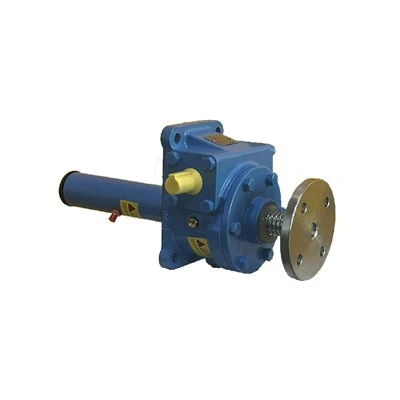
Trapezoidal Screw Jacks are precision lifting transmission devices composed of lead screws, worm and worm gear sets, bearings and precision housings. Storage environment and placement methods directly affect their performance. Improper storage leads to rusting, deformation, seizing and accuracy loss. Standard storage management covers four aspects: environment control, pre-storage treatment, proper placement and long-term maintenance.
First, requirements for storage environments. Jacks must be kept inside dry, ventilated and flat warehouses or workstations. Outdoor storage and rain exposure are forbidden. Humidity must be controlled to stop moist air from entering internal structures and oxidizing metal parts. Keep the equipment far away from acid, alkali, heavy dust, oil stains and corrosive gas. Do not store jacks directly inside chemical or dusty workshops, as corrosive substances erode thread surfaces and damage lubricants. Dust accumulated inside thread gaps causes abrasion and jamming during subsequent operation. Besides, avoid intense sunlight and freezing conditions. Extreme temperatures deform housings, solidify and degrade grease, and trigger cracking of rubber seals.
Second, pre-storage preparation is critical for protection. Before storage, thoroughly clear dust, iron filings, oil and water residues on lead screw threads and housing crevices. After cleaning, evenly coat all exposed threads and movable transmission parts with high-quality anti-rust lubricating grease to isolate air and resist oxidation. Fully retract the lead screw to its lowest stroke position to minimize exposed thread areas and prevent collision and rust on precision threads. Wrap cables and connectors properly to avoid dampness and breakage.
Third, follow standardized placement rules. Place jacks horizontally or upright on flat pallets or soft cushions to avoid direct contact with damp ground. Never stack multiple jacks or place heavy loads on housings or lead screws. External compression bends lead screws, deforms housings and displaces internal transmission assemblies. Maintain sufficient spacing between stored units to prevent collision scratches, thread damage and loose components.
Fourth, maintenance during prolonged storage. Frequent maintenance is unnecessary for short-term storage. For idle equipment stored long-term, conduct monthly visual inspections to check if anti-rust grease dries or peels off and whether rust spots emerge on threads. Replenish anti-rust lubricating grease every one to two months. Manually run the jack under no load several times to distribute grease evenly on transmission parts and prevent dry seizing. Keep the equipment powered off throughout storage to avoid short circuits and premature aging of electrical components caused by dampness, fully preserving equipment integrity.

 English
- English
- Français
- Deutsch
- 日本語
- Italiano
- Español
- Português
- русский
- slovenščina
- Eesti
- Polski
- dansk
- O'zbek
- Melayu
- বাংলা
- עברית
- Kreyòl Ayisyen
- Türkçe
- Català
- Svenska
- Čeština
- اردو
- عربي
- हिंदी
- ไทย
- Latviešu
- Lietuvių
- فارسی
- Cymraeg
- bosanski
- slovenčina
- Gaeilgenah Éireann
- 한국어
- українська
- hrvatski
- íslenska
- Ελληνικά
- Srbija jezik (latinica)
- România limbi
- Malti
- Việt Nam
- Nederlands
- Indonesia
- Bai Miaowen
- suomi
- Norsk
- magyar
- Български