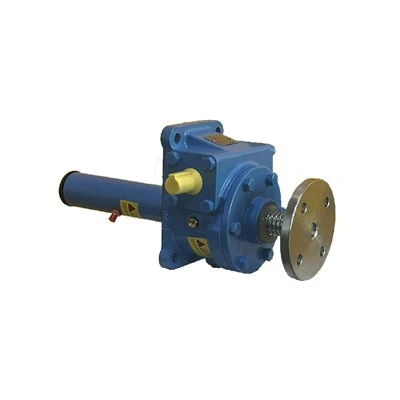
Electric Linear Actuator is an indispensable terminal execution device in industrial automatic control systems. Its core function is to receive electric signals from the control system and convert electric energy into mechanical power such as rotation and linear motion efficiently, so as to drive supporting equipment including pipeline valves, air dampers and regulating mechanisms to perform preset actions. It serves as a critical bridge connecting intelligent control centers and on‑site mechanical equipment, and is applied in many key fields covering industrial production, municipal operation and energy supply. Compared with manual, pneumatic and hydraulic driving modes, Electric Linear Actuator stands out for its outstanding adaptability, precision and automation level, making it a fundamental component for modern industrial intelligent working conditions.
In terms of working principle, Electric Linear Actuator receives weak electric control signals from PLCs, temperature controllers, remote control cabinets and other devices. Through coordinated operation of internal motors, reduction mechanisms and transmission assemblies, it amplifies output torque and drives matched equipment to achieve full opening, full closing, fine adjustment and constant‑position holding. By doing so, it accurately regulates the flow, pressure and velocity of water, steam, oil‑gas and chemical media inside pipelines, as well as the opening degree of air ducts and flues to stabilize equipment operating conditions. Its core value lies in realizing automatic unattended operation. It completely replaces traditional manual opening, closing and adjustment of equipment, and effectively avoids problems such as delayed response, uneven force and insufficient precision caused by manual intervention.
In practical industrial scenarios, the functions of Electric Linear Actuator can be divided into three core aspects. First is precise regulation. It supports stepless adjustment and fixed‑point positioning control with minimal positioning error. It can fine‑tune equipment status according to real‑time changes of working conditions to maintain constant production parameters, which is especially suitable for scenarios requiring high parameter stability such as fine‑chemical processing, precision water treatment and heat supply. Second is safety protection. Built‑in overload, over‑temperature and limit protection functions enable the device to cut off power automatically when jamming, overload or over‑travel occurs during operation. This prevents damage to valves, pipelines and motors, and avoids safety accidents including medium leakage and equipment rupture.
Third is remote intelligent management. Modern Electric Linear Actuator supports bus communication and remote signal transmission for integration into IoT control systems. Operators can complete equipment start‑stop, parameter adjustment and status monitoring in the central control room without going to site, which greatly lowers operation risks in high‑altitude, high‑temperature and high‑risk working sites. Meanwhile, it feeds back real‑time operating data and fault information to help maintenance personnel troubleshoot rapidly and realize intelligent equipment maintenance. In addition, Electric Linear Actuator delivers stable power output with controllable response speed, free of lag and impact. It can maintain consistent working status for a long time, effectively improving the overall operating stability and production efficiency while cutting maintenance costs. It acts as a key guarantee for industrial automation upgrading and working‑condition safety management.