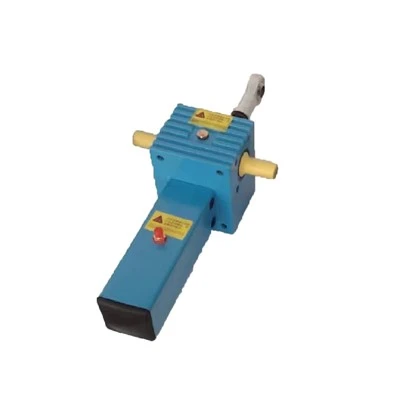
Abnormal noise emitted by the Right Angle Bevel Gearbox during operation serves as the most intuitive indicator of abnormal operating conditions. Such noise rarely arises from a single fault. Root causes mainly fall into four categories: lubrication conditions, internal components, installation & load status, and external environment. Most noise problems can be resolved through targeted inspection to prevent further fault deterioration.
First of all, lubrication issues represent the most prevalent trigger for abnormal noise. Bevel gears rely on lubricant to form an oil film for buffering meshing friction. If the lubricant filling volume is inadequate, if the oil oxidizes and deteriorates after prolonged service, contains excessive contaminants, or if the selected lubricant grade fails to match working conditions, an effective protective oil film cannot form between gears and bearings. Direct rigid friction between metal parts will generate continuous fine grinding noise. If ignored for a long time, tooth surface abrasion and bearing seizure will occur, making noise increasingly obvious. Meanwhile, blocked lubricant passages and uneven lubrication distribution may cause partial dry friction and intermittent noise.
The second factor involves wear and damage of core components. After long-term operation, natural wear appears on the tooth surfaces of bevel gears. Continuous overload and frequent start-stop operations will accelerate tooth surface spalling, scratches and tooth breakage, creating uneven gear meshing clearances and regular impact noise during rotation. Furthermore, internal bearings are high-wear components. Worn bearing rolling elements, deformed cages, rust and seizure lead to bearing rotation obstruction, producing humming or stalling noise. Minor deformation of gear shafts, loosened key connections and offset fit clearances between components will disrupt stable meshing and cause irregular abnormal noise.
Thirdly, improper installation and abnormal load conditions contribute to noise problems. An uneven mounting base, loose fixing bolts and excessive misalignment with mating equipment will cause slight shaking and vibration of the Right Angle Bevel Gearbox during operation. Dislocation and collision between components consequently create mechanical noise. Continuous overloading and sudden load surges raise gear meshing pressure beyond the normal range and produce impact noise during meshing. Frequent start-stop and forward-reverse rotation repeatedly impact the gear meshing structure, widening clearances and loosening fits, which gradually aggravates abnormal noise.
Finally, foreign contaminants and environmental influences play a role. In dusty working conditions, fine particles penetrate through housing gaps and mix into lubricant. These impurities grind between gears and bearings and create abrasive noise. In addition, if a Right Angle Bevel Gearbox that has been idle for an extended period restarts operation, internal parts may experience slight rusting and adhesion. Temporary noise will appear at the initial operation stage. If noise persists after running-in, it indicates permanent damage to internal components. In daily use, operators can accurately identify root causes according to noise patterns and occurrence timing, and carry out maintenance promptly to guarantee stable equipment operation.

 English
- English
- Français
- Deutsch
- 日本語
- Italiano
- Español
- Português
- русский
- slovenščina
- Eesti
- Polski
- dansk
- O'zbek
- Melayu
- বাংলা
- עברית
- Kreyòl Ayisyen
- Türkçe
- Català
- Svenska
- Čeština
- اردو
- عربي
- हिंदी
- ไทย
- Latviešu
- Lietuvių
- فارسی
- Cymraeg
- bosanski
- slovenčina
- Gaeilgenah Éireann
- 한국어
- українська
- hrvatski
- íslenska
- Ελληνικά
- Srbija jezik (latinica)
- România limbi
- Malti
- Việt Nam
- Nederlands
- Indonesia
- Bai Miaowen
- suomi
- Norsk
- magyar
- Български