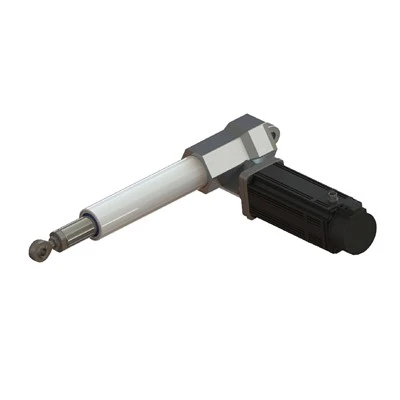
The Trapezoidal Screw Jack is a mechanical lifting device whose core transmission component is a trapezoidal thread pair. Fundamentally, manual power or external power drives screw rotation. Using the inclined-plane principle of trapezoidal threads, the jack converts circumferential rotary motion into axial linear thrust of the screw rod, achieving lifting, lowering and static support positioning of heavy loads. Compared with ball screw jacks, trapezoidal threads feature a wider tooth cross-section and larger thread contact area, which delivers stronger pressure-bearing capacity alongside inherent reliable self-locking characteristics. This self-locking property is its most critical functional feature. Self-locking means that once rotational driving force is removed, the screw rod will not rotate and sink automatically under the weight of heavy objects within the rated load range. It can maintain the current support height for extended periods without extra braking and locking mechanisms, greatly improving safety during static operations.
Beyond lifting tasks, it can also fine-level heavy objects. Trapezoidal threads have a small lead. When turning the handwheel or drive shaft, the screw rod travels only a short axial distance, enabling high-precision height adjustment. During installation of heavy equipment, operators can correct horizontality and fine-tune component gaps. Height can be adjusted incrementally to precisely control equipment levelness and avoid positional deviation caused by one-time large-amplitude lifting. Besides upward lifting, downward pressurization can be achieved under suitable working conditions to complete component compression and pre-tension fixation.
Its load-bearing support function is especially vital in numerous engineering scenarios. After heavy objects are lifted to the designated height, the Trapezoidal Screw Jack can bear loads over long periods and act as temporary support points. Many working environments forbid long-term load bearing with hydraulic jacks, because hydraulic components carry internal leakage risks and support height will gradually drop. In contrast, trapezoidal screw structures have almost no pressure-relief issues and are suitable for static load bearing lasting several hours or even days.
Furthermore, it enables displacement limiting and assists component resetting. During equipment maintenance and component disassembly and assembly, it can slowly apply thrust to move stuck heavy components at a controlled speed, preventing collision damage from sudden sliding. In bridge and steel structure assembly and disassembly, multiple jacks can be deployed synchronously to collaboratively control component lifting height, distribute overall loads and protect the original structure from damage induced by concentrated stress.
Even so, its functions have clear limits. As it relies on sliding friction transmission between threads, the Trapezoidal Screw Jack has high frictional resistance, low transmission efficiency and slow lifting speed. Thus it is not suitable for applications requiring rapid lifting and lowering. Frequent reciprocating operations will accelerate thread wear and generate substantial heat.
In summary, the core functions of the Trapezoidal Screw Jack combine lifting, leveling, static support, slow pressurization and auxiliary component displacement. Leveraging the self-locking and high-strength load-bearing properties of trapezoidal threads, it can be operated manually in power-free environments and complete operations purely through mechanical structures. Positioned as a heavy-load static support tool rather than a rapid lifting tool, it must be applied in accordance with its performance characteristics. Misuses such as overloading, impact loads and continuous dynamic stress must be avoided to fully exploit the safety advantages brought by mechanical self-locking and ensure stable progress of heavy load support, equipment installation and maintenance work.