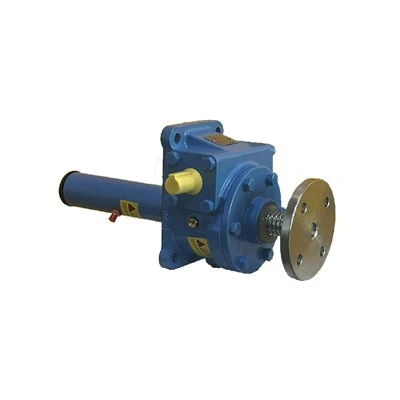
The core working principle of the Right Angle Bevel Gearbox is based on the spatial intersecting-shaft meshing theory of bevel gears. Unlike standard spur gears that use parallel-shaft transmission, its key transmission components are a pair of bevel gears with mutually perpendicular axes, which enables 90-degree power redirection. The complete transmission system mainly consists of an input shaft, driving bevel gear, driven bevel gear, output shaft, bearings, housing and sealing assemblies. All components work together to accomplish power direction conversion and torque transmission. During operation, power from the prime mover travels through the input shaft to the driving bevel gear. The driving gear rotates synchronously with the input shaft and engages tightly with the driven bevel gear via precisely machined tooth surfaces. Leveraging the mechanical properties of the conical tooth profile of bevel gears, it converts rotational torque parallel to the housing end face into rotational torque perpendicular to the input shaft, and finally outputs power through the output shaft to achieve 90-degree right-angle power redirection.

During power transmission, the involute tooth profile design of bevel gears ensures continuous and stable meshing and prevents transmission jamming or power interruption. Meanwhile, the Right Angle Bevel Gearbox can switch between forward and reverse rotation, single-shaft output and synchronous dual-shaft output by adjusting the gear tooth ratio and gear mounting orientation according to equipment operating conditions to satisfy diverse power output requirements of different machines. Compared with conventional redirection transmission structures, the gear meshing clearance of the Right Angle Bevel Gearbox is precisely calibrated, resulting in very low power loss during transmission, with transmission efficiency consistently maintained above 95%. In addition, the housing adopts a closed structure filled with lubricating oil, which continuously lubricates and cools moving parts such as gears and bearings to reduce mechanical wear and support long-term stable operation of the transmission system. This is a critical characteristic that makes it suitable for continuous industrial operation scenarios. Its overall transmission logic is simple and reliable without redundant complex structures, and it integrates multiple transmission functions including direction change, speed stabilization and torque amplification.