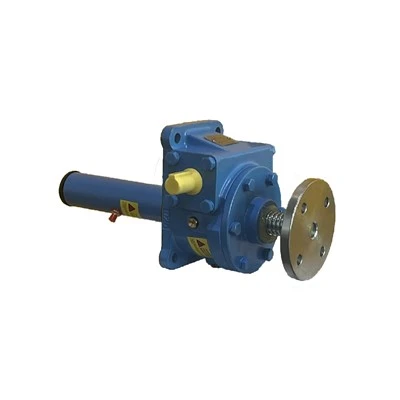
Vibration generated by the Worm Screw Jack falls into two categories: slight normal vibration and fault‑induced abnormal vibration. Normal vibration represents inherent mechanical characteristics and will not harm equipment performance or service life. Abnormal vibration serves as an early warning of malfunctions and demands timely identification and disposal. Compared with gear‑driven or chain‑driven lifting devices, the Worm Screw Jack adopts compact meshing transmission and delivers excellent shock absorption. Its normal vibration amplitude remains far lower than that of alternative lifting solutions.
Normal vibration originates from transmission principles. During operation, the rotating worm shaft drives the worm gear for meshing movement. Tiny mechanical friction and transmission clearances are produced within meshing zones. Meanwhile, motor rotation and telescopic movement of lead screws generate slight mechanical oscillation. These combined effects create faint perceptible vibration. Typical features of normal vibration include uniform low magnitude, no sudden shaking or resonant noise, stable lifting speed and reliable positioning. No offset or jamming occurs under loaded conditions. This operating state is acceptable and does not need corrective measures.

Violent, continuous and irregular vibration signals equipment faults with multiple possible root causes, which deserve high priority in daily inspection. First come installation‑related problems. Uneven mounting surfaces, loose foundation bolts and inconsistent rigidity of base supports lead to unbalanced stress and obvious resonant shaking, representing the most frequent source of vibration‑related failures. Second is improper load application. Overloading, offset load centers and tilted force during lifting produce uneven stress on transmission assemblies and trigger heavy vibration. Long‑term operation under such conditions accelerates deformation and wear of the worm gear and worm shaft.
Transmission‑component defects constitute another major cause of abnormal vibration. Inadequate lubrication or deteriorated lubricant increases friction resistance at meshing interfaces. Transmission becomes unsmooth and generates vibration together with noise. Extended service wears out worm gear, worm shaft and bearings and enlarges transmission clearances, resulting in intermittent shaking. In addition, motor defects, misaligned couplings and bent lead screws break transmission balance and induce overall machine vibration. Trapped iron scraps and foreign debris inside meshing areas can also cause stalling accompanied by sudden vibration.
Abnormal vibration brings serious consequences. It impairs positioning accuracy and undermines working performance. It speeds up component wear and shortens equipment service life. In worst‑case scenarios, bolt detachment, part fracture and equipment overturn may take place and lead to safety accidents. Operators shall observe operating status continuously. Once aggravated vibration, abnormal noise, lifting jamming or body shaking are detected, cut off power supply immediately and carry out comprehensive fault diagnosis. Eliminate vibration failures by calibrating installation levelness, tightening fasteners, renewing lubricant, repairing worn components and standardizing load limits to guarantee safe and smooth equipment operation.