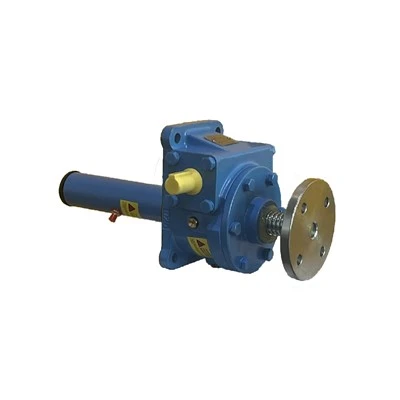
Ultra-smooth low-vibration operation is one of the core competitive advantages of the Heavy Duty Linear Actuator. It effectively resolves the prominent start-stop impact, operational jitter and system resonance issues that plague traditional heavy-duty drive equipment. It delivers exceptional vibration control across all heavy-duty linear motion applications, satisfying the rigorous stability requirements of precision machinery and automated systems with no perceptible large-amplitude oscillation or high-frequency vibration throughout operation. Its superior low-vibration performance stems from optimized control algorithms and refined structural design. In terms of control logic, the intelligent drive system implements S-curve acceleration and deceleration, replacing the abrupt start-stop control of conventional equipment. Gradual speed variation during startup and shutdown eliminates instantaneous mechanical impact peaks at the source, ensuring uniform velocity and stable force output throughout the full extension and retraction cycle.
Structurally optimized core transmission components further suppress vibration. High-precision ball screws and matched precision nuts minimize transmission clearances and ensure uniform force distribution, enabling linear, stable power transmission without stuttering, positional offset or stress-induced jitter. Internal specialized shock-absorbing gaskets and buffered limit mechanisms, combined with a high-rigidity integrated rigid frame, effectively absorb micro-mechanical vibration and prevent vibration amplification and propagation. Precisely calibrated gear meshing eliminates rigid collision during transmission, further reducing frictional micro-vibration and improving overall transmission smoothness significantly.

In practical rated-load and constant-speed working conditions, the Heavy Duty Linear Actuator maintains extremely low vibration amplitude with no visually observable shaking. Only subtle, steady mechanical pulsation is detectable through physical contact, without high-frequency jitter, sudden tremors or large-scale displacement fluctuation. During standard start-stop cycles and continuous reciprocating operation, vibration levels remain fully controllable, causing no structural deformation, precision degradation or stability loss in paired equipment and never triggering whole-system resonance. This makes it ideal for precision processing, medical equipment, intelligent detection and other vibration-sensitive scenarios with stringent stability standards.
Mild vibration only appears under two extreme working conditions. First, short-term full-load extreme overload operation generates faint low-frequency mechanical vibration, which poses no safety risk and disappears immediately once the overload condition ceases. Second, unregulated instantaneous high-speed start-stop operation without S-curve tuning produces minor transient impact vibration, which can be completely eliminated through parameter recalibration. Noticeable abnormal vibration is almost always caused by external factors including loose installation, uneven mounting bases, insufficient lubrication and eccentric loading, rather than inherent device defects, and can be fully resolved through standardized installation calibration and routine maintenance. Overall, the Heavy Duty Linear Actuator outperforms traditional hydraulic, pneumatic and screw-based heavy-duty equipment in vibration suppression capability, delivering outstanding long-term operational stability for continuous industrial applications.