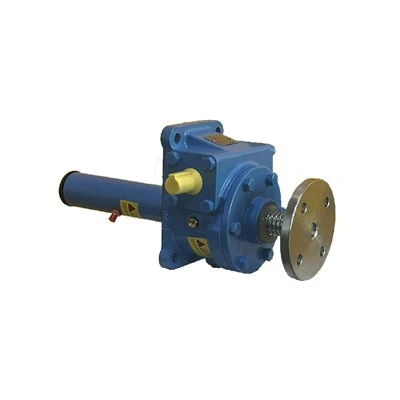
The speed stability of Multi Stage Linear Actuator fundamentally depends on its transmission structure, control system, load conditions and manufacturing quality. Standard certified products feature outstanding uniform motion performance and satisfy the operational demands of most industrial and civilian scenarios. Its core transmission principle relies on a motor that drives reduction gear assemblies to actuate multi-stage lead screw and nut structures for reciprocating linear movement. Unlike hydraulic and pneumatic actuators, its purely mechanical transmission eliminates speed fluctuations induced by air pressure or oil pressure variations, which constitutes its core advantage in consistent speed performance.
Under standard working parameters - rated voltage, rated load and even force bearing - Multi Stage Linear Actuator achieves an extremely small margin of error in telescoping speed. It moves uniformly throughout the entire stroke without mechanical jitter or sudden acceleration and deceleration. Under no-load or partial-load operation, speed remains nearly constant with no visible fluctuation. When carrying full rated load, increased mechanical transmission resistance triggers a mild, consistent speed reduction of 5%–10% across the whole stroke, rather than erratic fast-slow movement. This natural mechanical trait does not interfere with normal equipment operation.
Some customized high-precision Multi Stage Linear Actuators integrate closed-loop servo control systems and variable frequency speed regulation modules. These systems monitor travel distance and power output in real time and automatically compensate speed loss generated by load changes, drastically boosting speed stability with speed error controlled within 2%. They are widely deployed in precision lifting equipment, medical devices and automated production lines that impose stringent requirements for motion uniformity.
Conversely, inconsistent telescoping speed always stems from abnormal operating conditions or equipment malfunctions instead of inherent design defects. First, power supply issues: fluctuating voltage or insufficient power supply capacity directly causes irregular motor rotational speed and erratic movement. Second, excessive load: long-term overload, eccentric force bearing or mechanical jamming increases transmission resistance and triggers uneven speed. Third, component wear: dust buildup causing lead screw jamming, loose worn gears or dry faulty bearings break transmission balance and create unstable motion.
Additionally, low-cost inferior Multi Stage Linear Actuators suffer from minor speed fluctuations straight out of production due to low-precision transmission components and the absence of voltage stabilization compensation structures. Such performance defects will deteriorate continuously with prolonged service. In summary, certified standard units deliver steady telescoping speed under normal operating conditions. Any abnormal speed variation can be resolved by troubleshooting the power supply, adjusting load parameters or conducting routine equipment maintenance.