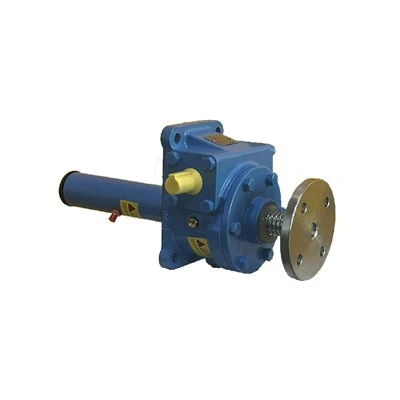
Regardless of sediment volume trapped in the gaps of a Trapezoidal Screw Jack, immediate startup and lifting work are not recommended. Forced operation will inflict irreversible damage to core components and introduce multiple safety hazards. The equipment can only resume normal service after thorough cleaning and inspection. Screw threads and transmission gaps constitute the core functional sections of Trapezoidal Screw Jacks. These areas feature tight fit clearances and are highly susceptible to particulate contaminants. Sediment consists of hard granular impurities; once embedded within gaps and thread contact surfaces, it directly disrupts the equipment' s normal transmission function. Many operators wrongly assume small amounts of sediment have negligible impact and choose to continue using the jack reluctantly. This practice continuously accelerates component degradation and significantly shortens overall service life.
When only a small quantity of sediment adheres to surface gaps without penetrating internal threads, the jack may seemingly lift loads normally, yet its actual operating condition has already deteriorated. During lifting cycles, sediment particles become sandwiched between mating thread surfaces, continuously scraping and abrading thread surfaces and gradually destroying original thread precision while increasing meshing clearances. In the short term, operators notice lifting jamming, laborious cranking speed fluctuations. Extended repeated operation with sediment causes thread wear and slackness. After reaching target height, the jack may experience slight load sinking and unstable support, greatly lowering operational reliability. Furthermore, surface sediment gradually works its way deeper into transmission structures, and accumulation eventually triggers more serious failures.
Operation must be prohibited when large volumes of sediment penetrate deep into screw thread gaps and internal transmission assemblies. In such cases, sediment directly blocks moving transmission components and prevents normal telescopic movement of the screw rod, resulting in seized lifting and erratic startup and shutdown. Forced operation causes thread deformation and misalignment of mating parts. In severe scenarios, screw rods suffer scratches, permanent deformation or complete failure, rendering the jack unusable. Additionally, operating with sediment contaminates internal lubricating grease entirely. Mixtures of sediment and grease lose all lubricating properties and function as abrasive slurry, continuously grinding core components and accelerating overall equipment wear.
The proper handling procedure is straightforward and does not require professional disassembly. First, thoroughly remove sediment and dust from surfaces and gaps using a soft brush or air blower to ensure no residual particles remain. Gently wipe impurities lodged deep inside gaps with cotton cloths. Do not scrape aggressively with hard tools, to avoid damaging screw threads. After cleaning, inspect the screw rod for scratches, deformation and binding. Next, evenly apply lubricating grease and conduct several manual test runs to spread grease fully across threads and smoothen transmission assemblies. The equipment can return to normal operation only after confirming smooth lifting with no abnormal resistance or jamming. Timely cleaning after outdoor and dusty applications prevents long-term sediment accumulation and protects the core structures of Trapezoidal Screw Jacks.