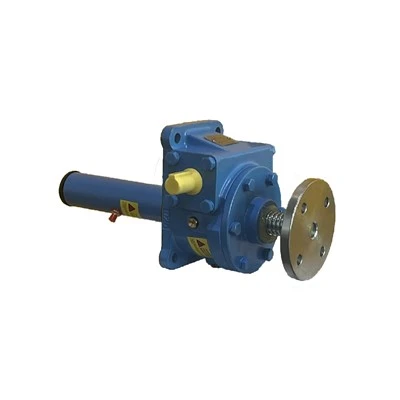
Whether a Trapezoidal Low Speed Screw Jack is suitable for long-term continuous operation cannot be determined simply by answering yes or no. The actual working environment, operating frequency, load conditions, and maintenance practices should all be considered. As a mechanical lifting and positioning device, it can be used in applications with relatively continuous operation, but extended use requires greater attention to operating conditions and routine maintenance.
Under normal working conditions, the Trapezoidal Low Speed Screw Jack can provide more stable continuous operation when its application is appropriate, its installation position is secure, and its moving components are properly lubricated. Its low-speed operation makes it easier for operators to monitor the equipment, but this does not mean that the effects of long-term operation and mechanical wear can be ignored.
During prolonged operation, the screw and nut may remain in continuous relative motion. If lubrication is insufficient, friction may gradually increase, making lifting less smooth. Therefore, during continuous use, the lubrication condition should be checked according to the actual operating frequency and working environment. Dust, debris, and contaminants should also be removed from moving areas, followed by appropriate lubrication when necessary.
Operators should also pay attention to changes in operating noise and movement. If the Trapezoidal Low Speed Screw Jack normally operates smoothly but begins to produce unusual noises, intermittent movement, increased resistance, or changes in lifting performance after extended use, this may indicate that its operating condition has changed. In such cases, continued long-term operation should be avoided until the cause has been checked.
The working environment can also affect continuous operation. For example, in dusty, humid, or heavily contaminated environments, foreign particles may accumulate on the screw and other moving components and interfere with normal operation. When the screw jack is used in such environments, cleaning and protection become particularly important. Keeping the equipment and moving areas clean can help reduce the effects of contaminants on mechanical movement.
If the screw jack is required to keep a load raised for an extended period, its actual use should also be considered carefully. A screw jack is primarily intended for lifting and positioning. When long-term fixed support is required, reliable auxiliary supports should be used according to the working conditions rather than relying solely on the screw jack for prolonged static support.
To maintain stable performance during long-term use, it is helpful to establish a simple routine inspection process. Before operation, check whether the screw is clean and whether the connection points are secure. During operation, pay attention to unusual noises, resistance, or irregular movement. After use, remove dust and contaminants from the surface and moving components.
Therefore, the Trapezoidal Low Speed Screw Jack can be used in applications involving continuous operation, but long-term use should be supported by proper inspection, cleaning, lubrication, and operating practices. Maintaining suitable working conditions and avoiding continued operation when abnormalities occur can help preserve smooth and stable performance.