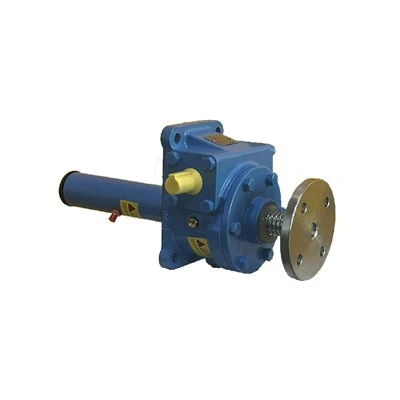
Engineered for heavy‑duty working conditions, the High‑load Lift Linear Actuator features outstanding operational stability. Compared with hydraulic and pneumatic lifting structures, its mechanical‑transmission mode provides higher controllability and more uniform motion, perfectly suiting diverse high‑stability‑demand scenarios including industrial heavy‑duty lifting, equipment alignment, platform support, and heavy‑material hoisting. Its overall performance surpasses that of ordinary light‑duty actuators.
In terms of core structure, it adopts precision‑ball‑lead‑screw or trapezoidal‑lead‑screw transmission, paired with high‑precision quenched gear sets and an integrated transmission housing. It achieves extremely small transmission clearances and effectively avoids transmission backlash, stalling and shaking. The lead screw' s spiral‑transmission structure converts rotary motion into uniform linear motion, so lifting speed remains controllable without abrupt acceleration or deceleration. Meanwhile, its built‑in damping‑buffer structure and start‑stop buffering program ensure soft starts, stops and commutation, with no instantaneous impact or violent shaking even under heavy loads.
Regarding load‑adapted stability, the actuator possesses strong heavy‑load pressure‑resistance capacity. Ordinary lifting equipment tends to tilt, jitter and shake due to pressure relief under heavy loads. Optimized through mechanical design, the High‑load Lift Linear Actuator features uniform stress points and strong axial load‑bearing capacity. It can vertically sustain rated heavy‑loads stably without offset or tremor induced by self‑weight. Even when switching among partial‑load, full‑load and intermittent‑load working conditions, it maintains stable operation with precise stroke control and high repeat‑positioning accuracy, meeting demands for precision‑equipment support and heavy‑workpiece fine‑tuning.

Its operational stability also benefits from complete noise‑reduction and shock‑absorption design. The whole machine adopts an enclosed‑housing structure with precisely‑fitted internal components and no loose clearances. Vibration generated by gear meshing and lead‑screw friction is effectively offset, resulting in low‑amplitude vibration. Meanwhile, the base is fitted with anti‑slip and shock‑absorption structures. After fixed installation, it absorbs minor operating vibration to prevent equipment resonance and platform shaking, securing overall stability for lifting platforms and carried equipment alongside low noise and minimal vibration.
Nevertheless, its stability is affected by installation, working‑condition parameters and component wear. Non‑vertical installation, loose fixing bolts, and eccentric force produce offset and jitter during operation. Long‑term lubrication shortage and component wear trigger transmission stalling. Overload operation and instantaneous impact loads compromise operating balance. These issues stem from improper usage rather than inherent equipment‑performance defects. With standardized installation, compliant operation and regular maintenance, the High‑load Lift Linear Actuator can sustain superior long‑term operational stability, outperforming comparable lifting‑transmission equipment in stability and reliability.