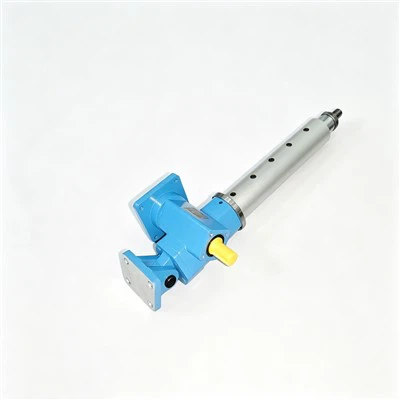
With the continuous upgrading of modern intelligent manufacturing, industrial automation equipment requires stable mechanical adjustment, strong structural rigidity and long-term continuous working performance. The dermail transmission cast iron housing screw jack stands out among various linear actuators due to its thick integral cast iron shell, excellent vibration resistance and stable mechanical self-locking. Unlike lightweight alloy jacks that are only suitable for light-load static environments, cast iron housing models are specially optimized for complex automation workshops with vibration, load fluctuation and frequent start-stop actions. This article elaborates on its core application scenarios and irreplaceable advantages in the automation industry.

1. Automated Assembly & Tooling Positioning
In automated assembly lines, precise height calibration and fixed clamping positioning are essential for batch production. Cast iron housing screw jacks are widely used for lifting assembly platforms, adjusting tooling brackets and locking fixture positions. The high-rigidity cast iron body effectively absorbs mechanical vibration generated by robotic arms and automated manipulators, avoiding positioning offset caused by equipment shaking. In addition, relying on the stable worm gear transmission structure, it maintains consistent lifting accuracy during repeated cyclic actions, ensuring uniform assembly tolerance for finished products. Multiple jacks can be connected through transmission shafts to realize mechanical synchronous lifting, which is an economical and reliable leveling solution for large automated assembly frames.
2. Conveying & Sorting Automation Lines
Logistics conveying lines and intelligent sorting equipment need frequent height switching and angle correction to match different production processes. Heavy-duty cast iron screw jacks are installed at the bottom of conveyor racks and sorting baffles to complete regular height adjustment. The thick cast iron shell is resistant to structural deformation under long-term alternating load, effectively adapting to continuous material transportation and mechanical impact. Compared with hydraulic cylinders, this mechanical jack has no oil leakage risk, keeping the conveying line clean and reducing downtime maintenance frequency. Multiple input modes such as electric linkage and manual debugging meet both automatic operation and daily inspection requirements.
3. Processing Machinery & Machining Auxiliary Equipment
In CNC processing workshops and automated machining stations, machine tool frames and auxiliary processing tables need stable mechanical leveling. Cast iron housing screw jacks provide strong supporting force and anti-vibration performance for mechanical processing equipment. Its internal trapezoidal screw has reliable self-locking ability, which can permanently lock the height of the workbench without displacement during high-speed cutting and drilling. The heat-resistant and anti-deformation characteristics of cast iron material make it work stably in high-temperature and oil-fog workshops, effectively extending the service life of transmission components.
4. Intelligent Packaging & Forming Machinery
Automated packaging machines, pressing molding equipment and blister molding machines require regular mold replacement and gap adjustment. Cast iron screw jacks are applied to the vertical lifting of molds and the precise spacing adjustment of pressing rollers. The compact integrated structure is easy to integrate into limited mechanical space, and various screw head types such as threaded head and flange head can meet diversified mold connection methods. Its low-speed stable lifting performance prevents mold collision and mechanical impact, greatly reducing the failure rate of packaging and molding equipment.
5. New Energy & Electronic Automation Equipment
In the production process of batteries, photovoltaic modules and electronic components, automated production equipment needs stable and low-jitter linear adjustment. Cast iron housing screw jacks are used for lifting battery assembly tooling, calibrating photovoltaic production brackets and adjusting electronic testing platforms. The excellent structural rigidity avoids tiny shaking during component assembly, ensuring product processing consistency. Customizable stroke and transmission ratio adapt to diversified production rhythms of new energy automated workshops.
6. Automated Storage & Vertical Warehousing System
Intelligent stereoscopic warehouses and automated storage racks require regular height switching and cargo layer adjustment. Heavy-duty cast iron screw jacks serve as the core lifting unit of storage racks, providing stable vertical displacement and heavy-load supporting capacity. The fully enclosed cast iron shell prevents dust and moisture from entering the internal transmission structure, adapting to long-term unattended operation in automated warehouses. Simple mechanical structure reduces electronic failure points, making it more suitable for industrial storage environments than electric cylinders.
Conclusion
To sum up, the cast iron housing screw jack has become an indispensable basic linear actuator in the automation industry. Its unique cast iron rigidity, stable mechanical transmission and diverse installation forms perfectly match the high stability, high safety and low failure rate requirements of modern automated production. From assembly lines and conveying equipment to new energy processing and intelligent warehousing, it continuously provides heavy-duty, durable and cost-effective linear motion solutions for global automated mechanical equipment.